Practice address
Avenue Alexandre-Vinet 25, 1004 Lausanne, 3rd floor. Doorbell and entry code are sent with your appointment confirmation.
A gentle, natural approach to harmonising your emotions and restoring your inner balance
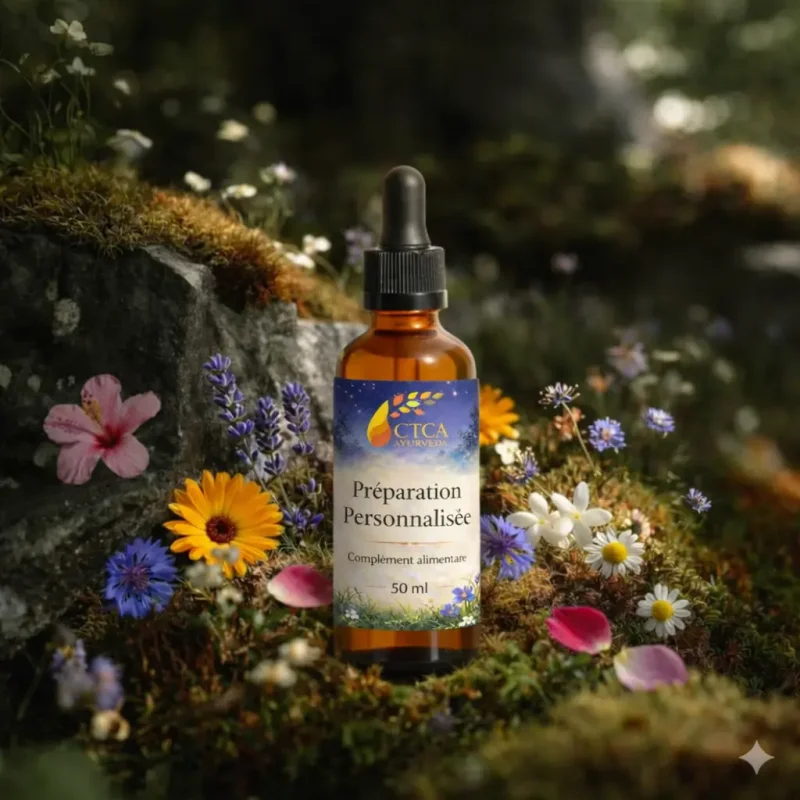
Custom-made preparation
50 ml · Made in Lausanne
Bach Flowers are flower elixirs developed in the 1930s by Dr Edward Bach, a British physician and homeopath. This gentle therapy is based on the use of 38 quintessences of wild flowers, each corresponding to a specific emotional state.
Dr Bach was convinced that emotional balance was the key to good health. He identified 38 basic negative emotional states and created a natural remedy for each one.
Bach Flowers do not directly treat physical symptoms, but act on the emotions and states of mind that may be the source of imbalances.
Each flower corresponds to a precise emotional state: fear, uncertainty, lack of interest, loneliness, hypersensitivity, discouragement or excessive worry.
Helps manage stress, anxiety and negative emotions
Gentle and natural method without side effects
Promotes inner peace and serenity
Accompanies through life's daily challenges
Discover the most common use cases where Bach Flowers can support you
Flowers such as Rescue Remedy, Mimulus and Aspen are recognised for their soothing effect on nervous tension and diffuse worry.
Star of Bethlehem and the Rescue blend are specifically used to support people after a traumatic event (accident, bereavement, difficult news).
Olive and Hornbeam work well for overwork, mild burnout or stress-related fatigue.
Mimulus is particularly suited for fears with a known origin (fear of the dark, animals, illness, etc.).
Clematis and White Chestnut help refocus attention and calm an agitated mind.
Larch is the go-to flower for people who doubt their abilities and anticipate failure.
Walnut helps adapt to changes (moving, new job, separation, retirement) and protects against outside influences.
Impatiens soothes tense, hurried people who are easily irritated by others' slowness.
Pine works well for people who blame themselves for everything and carry an excessive burden of guilt.
Mustard is used for episodes of deep sadness that arrive without identifiable reason, like a dark cloud.
Centaury helps people who forget themselves for others and dare not set their limits.
Holly works on negative feelings towards others: jealousy, resentment, distrust.
Gentian supports people discouraged by obstacles who need to regain optimism.
Rescue Remedy and combinations including Larch, Mimulus or Elm are commonly used before evaluation situations.
White Chestnut is very effective at calming incessant inner dialogue and looping thoughts.
Identification of your current emotions and states of mind
Choice of flowers adapted to your situation (up to 7 essences)
4 drops, 6 times a day under the tongue or in a glass of water
Re-evaluation after 3-4 weeks and adaptation if necessary
Bach flower consultations take place at my practice in central Lausanne, or remotely if you prefer to fill in the online questionnaire.
Avenue Alexandre-Vinet 25, 1004 Lausanne, 3rd floor. Doorbell and entry code are sent with your appointment confirmation.
10 minutes from Lausanne train station, close to the Riponne-Maurice Béjart and Bessières stops. Riponne car park is a few minutes' walk away.
OrTra-certified complementary therapist, ASCA and RME accredited. Sessions are covered by most Swiss complementary insurance plans.
Lausanne and the whole Lake Geneva region: Renens, Pully, Prilly, Ecublens, Morges, Vevey, Montreux, Yverdon-les-Bains, Fribourg and Geneva.
1. Take the M2 towards Croisettes
2. Get off at Riponne–Maurice Béjart stop (2 stops)
3. Walk about 5 minutes:
• Go up Rue du Valentin
• Turn left onto Avenue Alexandre-Vinet
📍 25 Avenue Alexandre-Vinet is on your left
Street parking available
Blue zone - Don't forget your parking disc!
More questions?
Discover the experiences of our patients who have benefited from our care
We are currently gathering testimonials from our patients for this treatment. In the meantime, discover all our authentic reviews on our testimonials page.
View All TestimonialsDiscover our other therapeutic approaches that can enrich your wellness journey
Allergy and sensitivity elimination
Stimulation of auricular points
Holistic energy rebalancing
Holistic traditional Indian medicine
Pressure on the foot's reflex zones
Colour supporting inner balance
LED light for recovery and skin
Beyond the ready-to-use preparations, I compose custom blends tailored precisely to your situation and your current emotions.
You answer a guided questionnaire (≈ 3 minutes)
I get back to you within 24 h with a blend proposal
You order your 50 ml bottle directly or we discuss further
I prepare your bottle by hand and ship it to you
100% confidential · reply within 24 h
Explore our selection of individual flowers and personalised blends